Peloton cycling manager: your first steps
Peloton is a free online cycling manager game. Here are seven steps to get your team going: meet your cyclists, ride your first race, get to know your division, earn money, hire a trainer, buy new riders and find young talent with a youth scout.
A team that has no lineup for a race does not race and earns nothing. Open the Calendar, pick the next race and select Change in the column Tactics (see your first race). Lineups close at 12:45 CET/CEST on the day of the race. For a tour, choose your cyclists in the lineup of the first stage: you cannot join a tour once its first stage has been ridden.
Five mistakes new managers make
- No lineup for the race: no race and no prize money.
- No sponsor deal: without one, your team only earns the base income (20,000 a week in tier 4), far less than with a deal.
- A trainer you cannot afford: check the signing fee and the weekly wage first.
- Spending the whole balance on riders: wages are paid every week, and below zero you pay 5% interest a week.
- Empty merchandise shelves: stock up before the weekly update.
Meet your cyclists: skills explained
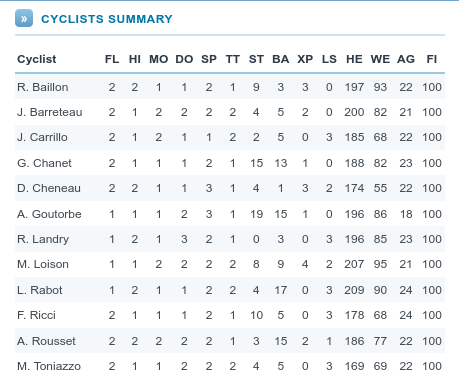
First, you should take a look at your cyclists. You can find them by selecting Cyclists in the side menu. When you start a new team, there are 12 cyclists in your squad. Soon it will be much more, but more on that later.
Primary skills
In addition to some general information such as age, fitness and wage you will find the most important skills of a cyclist here, his six primary skills. They determine the performance of a cyclist most. When you look at these skills you can see if your cyclist is a sprinter for flat stages, a mountain specialist, an allrounder for the grand tours, ... All skills are between 0 and 20. Here is an overview:
- Flat (FL): the better the flat skill, the faster the cyclist is on flat terrain.
- Hill (HI): the better the hill skill, the faster the cyclist is on a hilly section.
- Mountain (MO): the better the mountain skill, the faster the cyclist is in the mountains.
- Downhill (DO): the better the downhill skill, the faster the cyclist is in downhills. A good downhill skill also decreases the risk of a fall during a downhill.
- Sprint (SP): the better the sprint skill, the better the cyclist can sprint. This is important for final sprints, intermediate sprints and breakaways (for the attack).
- Time trial (TT): the better the time trial skill, the better the cyclist is in time trials. This is important for individual and team time trials and breakaways (during the breakaway).
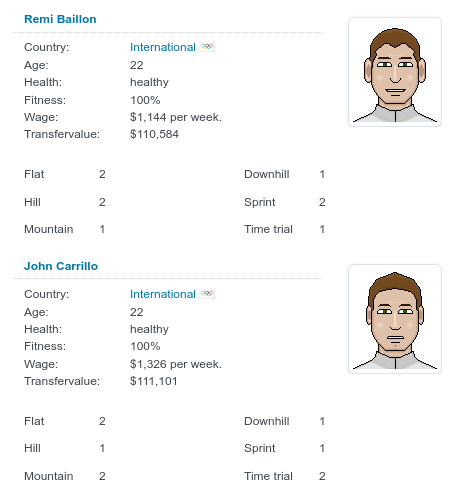
When you click on the name of a cyclist, you get more detailed information about him.
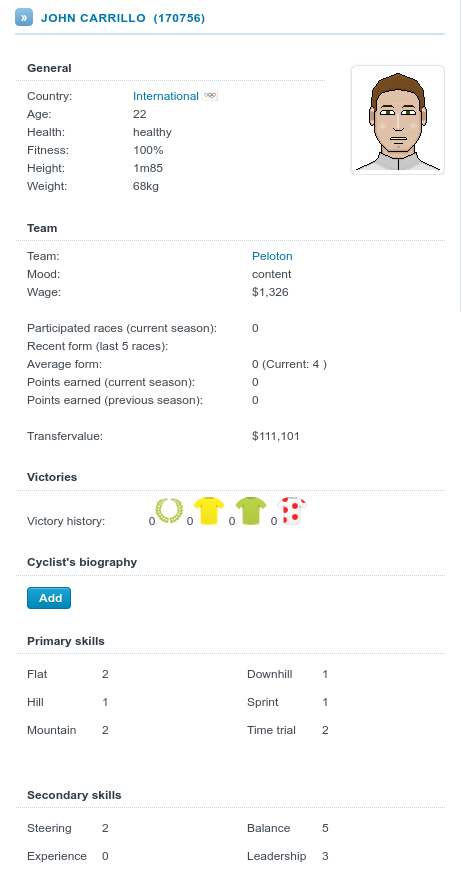
Age, fitness, health, height, weight and contract
- Country: the cyclist always has the nationality of the country of his first team.
- Age (AG): the age of the cyclist affects the training speed. The younger the cyclist, the faster he will improve his skills.
- Health: normally, your cyclist is healthy and can participate in races. However, he may get injured during a race or during training. As long as he is injured, he can take part in neither races nor training.
- Fitness (FI): if a cyclist participates in a race, his fitness decreases. A tired cyclist won't achieve much, while a cyclist with a fitness of 100% will use his full potential. The fitness increases by 20% after each weekly update (on Sunday at 20:00 CET/CEST).
- Height (HE): the height affects the performance of your cyclist on flat terrain. The taller the cyclist, the better he is in flat sections.
- Weight (WE): the weight affects the performance of your cyclist in mountain parts. The lighter the cyclist, the better he is in the mountains.
- Contract: every cyclist has a contract that counts down every week. The cyclists you start with have 60 weeks, about a year. When it runs out without a new agreement, he leaves your team. You negotiate a new contract under Contract negotiations.
Secondary skills
Steering and balance skills affect the risk of a negative incident during the race. Experience and leadership skills affect the performance of the cyclist. The secondary skills of a cyclist are between 0 and 20.
- Steering (ST): this skill affects the probability of a flat tyre during a race. The worse the steering of a cyclist, the more often he will have a flat tyre.
- Balance (BA): this skill affects the probability of a fall during a race. The worse the balance skill of a cyclist, the more often he will fall.
- Experience (XP): every point of experience adds about 1% to all the skills of a cyclist in a race, up to 20%. It grows with every race he rides.
- Leadership (LS): the leadership of your team leader (the first cyclist in your lineup) helps every cyclist who rides with him and gives you more tactics points (5 plus his leadership). It grows slowly while he rides as your leader, until he is 35.
Invisible skills
Every cyclist in Peloton has some invisible skills:
Future Ability (FA): each primary skill has a hidden Future Ability. It decides how fast a cyclist trains that skill. The FA of flat, hill, mountain and downhill is between 0 and 20 each, and together they always add up to 40, so a cyclist who is gifted in one terrain is weaker in another. Sprint and time trial are different: their FA is 15 for every cyclist.
The FA only counts from a skill of 7. Below 7, every cyclist trains as if his FA were 20, in all six primary skills, so all cyclists improve equally fast at the start. From 7 up, the hidden value takes over. A high FA keeps the training fast, a low one makes the next levels slow, and sprint and time trial train at a steady medium speed for everyone.
- Injury proneness: this skill affects the chance that a cyclist will get injured during training or during a race, caused by a fall.
My first race: lineup and tactics
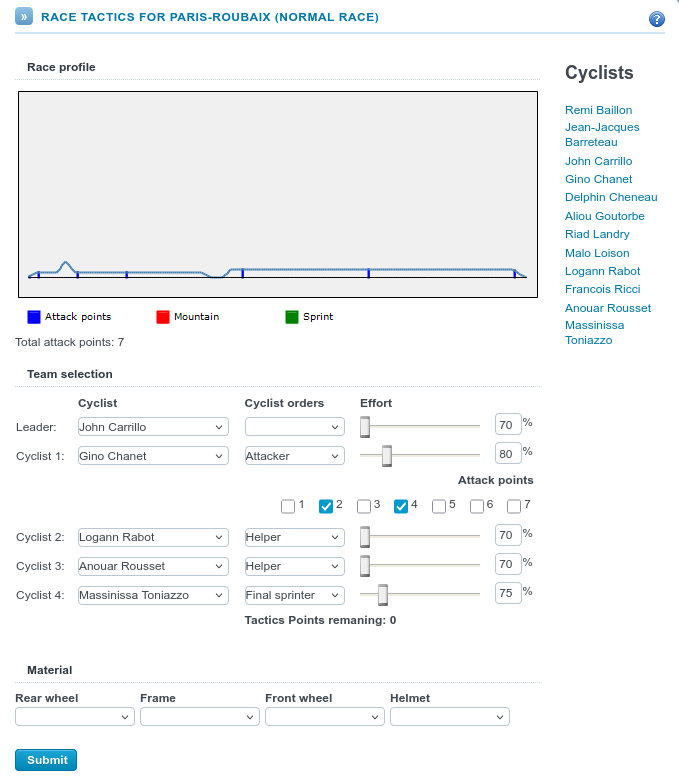
It's showtime! Since you know a lot about the skills of your cyclists, you can take part in your first race now. The page Calendar is the central starting point for everything about the race. There you will find all races, set the tactics and see the results. You can participate in a race by selecting Change in the column Tactics. Here you can choose the five participating cyclists and a tactic for each of them. You can even buy special material for that race, but that is not needed in your first season.
Cyclist selection
Use your first race for trial and error. Pick five cyclists whose skills look suitable for the terrain of the race (you get detailed information by clicking on the name of the race), and try different orders such as helper, attacker and final sprinter. Perhaps you will even achieve a good result! It's just a matter of time until you understand the tactics and the best cyclist selection for a certain race or tour.
Tactical orders
Your tactical possibilities are limited by the available Tactics Points (5 + the leadership skill of your team leader).
- Helper (1 tactics point): a cyclist with this order supports his teammates as well as possible, for example if they fall or have a flat tyre. A helper with a good terrain skill can also help a teammate with a bad terrain skill, so that he doesn't lose contact with the group and doesn't lose time. But he can only help his teammates if he is in the same group.
- Attacker (2 tactics points per attack): at some points of the race your cyclists can start a breakaway. Each of these attacking points is associated with a certain terrain. For a successful attack, the sprint skill and the terrain skill (terrain of the attacking point) are important. For a successful escape to the finish line, the time trial skill and the terrain skills (terrain after the attacking point) are important.
- Final sprinter (2 tactics points): if you expect that there won't be a successful breakaway, you can select your best sprinter as final sprinter. He gets a bonus on his sprint skill during the final sprint. He should have a good skill in the terrain where the race ends and he should still be in the peloton at the end.
- Save fitness (4 tactics points): a cyclist who saves fitness takes no initiative during the race and rides with 60% effort. The positive effect is that he loses only 1% of his fitness. This tactic can be useful in a tour: the cyclist saves his fitness for one of the following stages.
- General standings (no tactics points): for the cyclist who is your hope in the general classification of a tour. He cannot attack and gets no sprint bonus, but your helpers protect him: a helper who would finish ahead of him gets his time, so your helpers ride in with their leader. If your team also has an attacker or a final sprinter, the general standings cyclist is the one who is protected.
Effort and fitness
The higher the effort of your cyclists, the better they perform. But you have to take care of the fitness of your cyclists, because a cyclist rides with just (effort x fitness) % of his skills. There are a lot of races and you only have 12 cyclists at the beginning. A rider with 70% effort loses 5% of his fitness, a rider with 100% effort loses 35%. During the weekly update the fitness of all cyclists increases by 20%. In single races it makes sense for helpers to ride with a low effort, while cyclists who are supposed to win (attacker, final sprinter) ride with a higher effort. In tours your cyclists should ride with a low effort, except those who have a goal in that stage (stage win, points for the mountain or sprint jersey, ...).
Lineup deadline and race results
On a race day, for that day's race:
| When | What happens |
|---|---|
| Before 12:45 CET/CEST | set or change your lineup for that day's race |
| 12:45 | lineups close |
| 13:00 | that day's race is calculated; results right after |
Every week:
| When | What happens |
|---|---|
| Wednesday 19:00 | fun races |
| Sunday 20:00 | weekly update: training, fitness +20%, income and costs, merchandise sold |
You can change the tactics until 15 minutes before the race, so until 12:45 CET/CEST. If you want to take part in a tour, you only have to choose the participating cyclists in the tactics for the first stage of the tour. They are selected automatically for the other stages. The calculation of each race takes place at 13:00 CET/CEST. As soon as the races are simulated, you can click on the results. You can check the results immediately or watch the detailed simulation of the race. After each stage of a tour you also have access to the current standings of the tour. By clicking Standings you can check who is leading the tour in the different competitions.
Which teams are my competitors? Divisions, promotion and relegation
Once you have taken part in your first race, take a look at your division. There you find all the teams you compete against this season, and the division standings show how good your team is compared to the others.
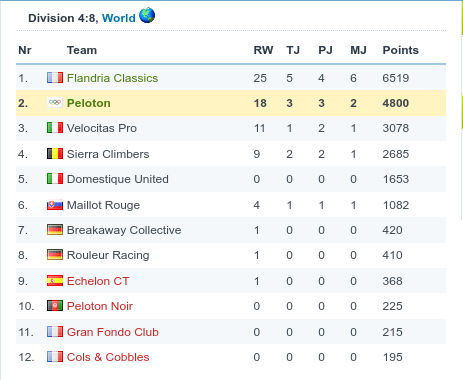
There are five tiers of divisions. Tier 1 is the highest, with one division; tier 2 has two divisions, tier 3 has four, tier 4 has eight and tier 5 has sixteen. A new team starts in the lowest tier that has teams. A division has room for 12 teams, but lower divisions are often not full, and all the teams are managed by players.
At the end of the season the two best teams of a division are promoted to a higher tier. The four weakest are relegated to a lower tier, but only in divisions that have enough teams. In the lowest tier relegation is not possible.
A team whose manager has not logged in for 8 weeks is set aside and leaves its division; the manager can come back at any time and gets a place again.
How to earn money: sponsor, merchandise and supporters
Your team will only improve in the long term if you take care of its finances. The most important sources of income for beginners are prize money in races, the sale of merchandise, the base income, the money from your sponsor and the money at the end of the season.
Base income and sponsor
Every team receives a base income every week, even without a sponsor. It depends on your tier: 50,000 a week in tier 1, 33,333 in tier 2, 25,000 in tier 3 and 20,000 in tier 4. A sponsor deal pays its weekly amount on top of it. On the Finances page both are shown together as sponsor income, so a new team without a deal sees 20,000 and one with a one-season deal about 44,000.
You can choose a sponsor by selecting the option Sponsor on the Finances page. You choose one of three offers for 1, 2 or 4 seasons. They pay the same amount in total for each season of the deal: what changes is how it is split. A one-season deal pays more at signing (in tier 4 about 100,000, against 75,000 for two seasons and 50,000 for four) and a bit less each week; longer deals pay a little more each week.
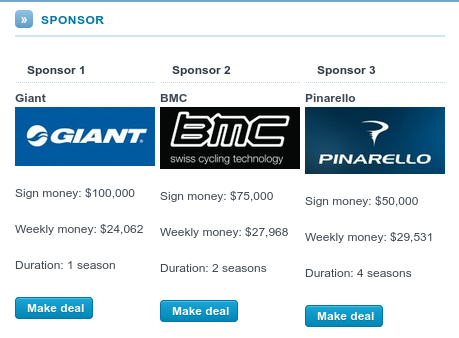
The amounts depend on the tier of your division and your place at the moment you sign, and they stay the same for the whole deal, even if you are promoted.
Money at the end of the season
At the end of every season each team is paid for its final place in the division. The better the place, the more it pays, and the amount depends on the tier: the champion of a division gets 200,000 in tier 1, 170,000 in tier 2, 140,000 in tier 3 and 110,000 in tier 4, and every lower place gets less.
The two promoted teams of a division also get a promotion bonus: 300,000 when they leave tier 4, 400,000 from tier 3 and 500,000 from tier 2. A team that moves up because places opened in the tier above gets the same bonus. In tier 1 the three best teams get 750,000, 500,000 and 250,000.
The team of the best cyclist of the division (the one with the most division points) gets 55,000 in tier 4, 70,000 in tier 3, 85,000 in tier 2 and 100,000 in tier 1.
Merchandise
For new teams, the revenue from the sale of merchandise is important. Make sure you always have enough merchandise in your shop during the weekly update. You can buy merchandise by selecting Supporters in the side menu. The more supporters you have, the more merchandise can be sold. There are four types of merchandise in Peloton:
| Article | Buying price | Suggested selling price | Price at which nobody buys |
|---|---|---|---|
| Bidon | $5 | $15 | $25 |
| Baseball cap | $10 | $20 | $30 |
| Sportsbag | $20 | $40 | $60 |
| T-shirt | $15 | $30 | $45 |
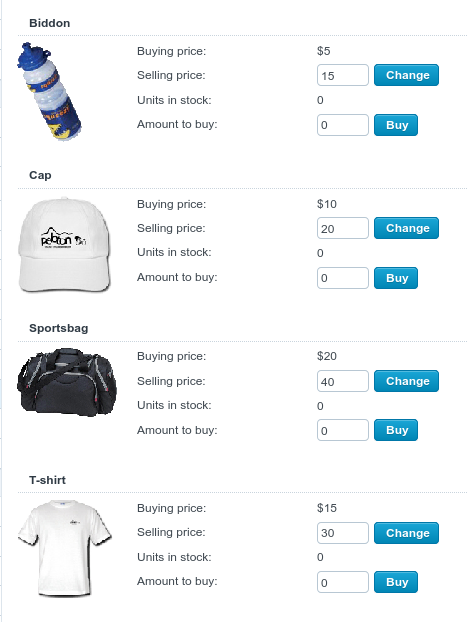
You can buy a number of each article and set the selling price. The items are sold during the weekly updates, and you get the difference between the selling and the buying price.
The higher your selling price, the fewer supporters buy: at the buying price everybody buys but you earn nothing, and at the highest price in the table nobody buys. What is not sold stays in your shop for the next week.
Supporters
Your total number of supporters has four parts:
- Core supporters: the loyal base of your team. It depends only on your tier: about 9,600 in tier 1, 6,000 in tier 2, 3,800 in tier 3, 2,400 in tier 4 and 1,500 in tier 5.
- Seasonal supporters: they come from your results in the last five seasons. A good place in a high tier counts most. A new team counts the seasons it has not played yet as place 12 in its current tier, so a new team in tier 4 starts with about 3,850 supporters in total.
- Opportunists: fans who join after good results: a good place in a race, and a jersey in a tour (more for a grand tour). The higher the tier, the more you win. Weather and temperature change it a little: warmer weather brings a few more.
- Disappointed supporters: you lose some if you do not enter a tour, or enter its first stage with fewer than three cyclists. The loss is bigger for grand tours.
After the weekly update the opportunists and the disappointed supporters are cleared: only the core and the seasonal supporters stay as the base amount. Especially after a successful race week you will have a large number of fans, so don't forget to buy enough merchandise.
Investments
Investments are for later, when your balance is comfortable. On the page Investments (under Finances) you lock an amount for 16 weeks. When the time is up you get your money back plus 10%. If you withdraw earlier, you pay 5% of the amount and get no interest. You can have up to 10 investments at once, each up to 2,500,000.
Hire a trainer and train your cyclists
Now you have to take the first important and long-term decision: what do you want to train?
You can hire a trainer by selecting the option Hire new trainer on the page Training. Here you can choose what skills your trainer will have. If you hire a new trainer, the skills are in a range between 0 and 15 (later you can train a skill up to 20).
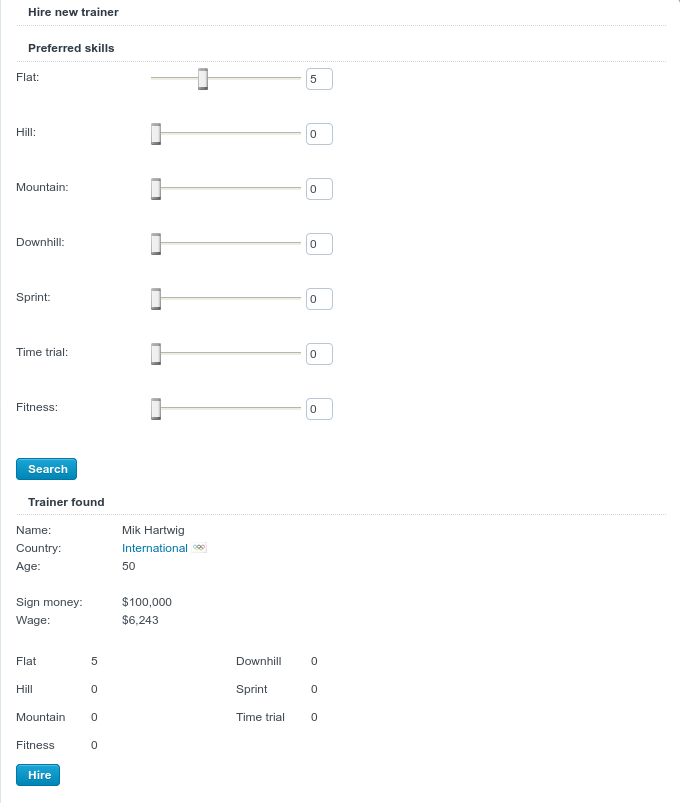
Trainer costs: signing fee and wage
The signing fee is 20,000 for every skill point of the trainer (all his skills added together). For a trainer with one primary skill (the other skills at 0), the prices are about:
| Trainer skill | Signing fee | Weekly wage | Training speed (about, per skill level) |
|---|---|---|---|
| 3 | 60,000 | 4,400 | 25 weeks |
| 5 | 100,000 | 6,200 | 15 weeks |
| 8 | 160,000 | 11,300 | 9 weeks |
| 10 | 200,000 | 16,800 | 7 weeks |
| 12 | 240,000 | 25,300 | 6 weeks |
| 15 | 300,000 | 48,100 | 5 weeks |
A higher skill trains faster but costs much more. A trainer with several skills costs the sum of all of them: a trainer with two skills at 10 costs 400,000 to sign (more than a new team has) and about 31,000 a week. The training speed is an estimate for a young cyclist with a low skill.
If you take a trainer with a very low skill in several disciplines, you can train more skills and pay a lower wage, but your cyclists improve very slowly.
As soon as you have hired your coach, you can start to improve his skill (up to 15 is enough for the beginning). You can do that with the option Learning skill. You pay 10,000 for each step, you can do only one step per week, and he asks for a higher wage afterwards. Once you have enough money and some experience, your trainer can learn a new skill (or improve his present skill even more).
Which skill should your trainer have?
What skill should you choose for your trainer? Downhill and especially fitness are not recommended for a beginner, but all other skills are useful and have some advantages.
- With a terrain skill (flat, hill, mountain) you can increase your chances in races with that terrain.
- The skill sprint is important for all sprint decisions (final sprints, points for the points and mountain jersey) and necessary for starting a breakaway.
- The skill time trial is important for ITTs, TTTs, the time jersey in grand tours and necessary during a breakaway.
But don't forget: good sprint and time trial skills are useless without a decent terrain skill.
When you choose the skill of your new trainer, it matters in what types of races you want to be successful. Don't worry: whatever skill you choose, with smart transfer management you will have cyclists for various types of races in your squad. Later your trainer can learn a second skill anyway.
Send your cyclists to training
Since you have a trainer now, you should send your cyclists to training regularly. Training takes place every Sunday at 20:00 CET/CEST, with the weekly update.
By clicking Training in the side menu you find an overview of your cyclists. Select the skill that your cyclist should improve. It makes sense to select only skills in which your trainer has a good skill, too. If he has no clue how to ride in the mountains, your cyclist won't improve his mountain skill. Since your trainer has only one or two good skills at the beginning, the choice isn't difficult.
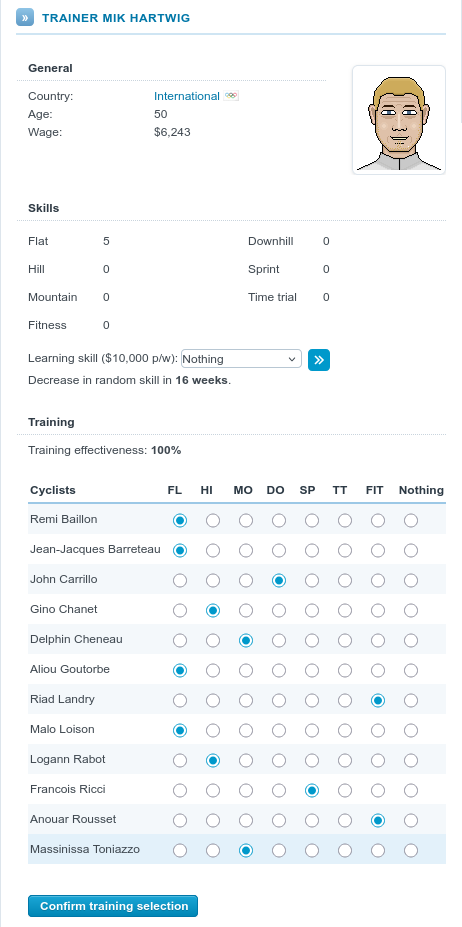
The training efficiency is irrelevant for you at the beginning, because you have only 12 cyclists. Your trainer can train up to 25 riders with full effectiveness. As soon as you send more riders to training, the effectiveness decreases.
Buy more riders on the transfer market
If you have looked at the calendar, you have surely noticed that there are a lot of races per season. If you only use your 12 original cyclists, they get tired soon and won't perform well. So it makes sense to look for new cyclists. Then you always have fit cyclists and a larger selection of suitable cyclists for each race. Your coach also gets more benefit, because, as you know, he can train up to 25 riders with full effectiveness.
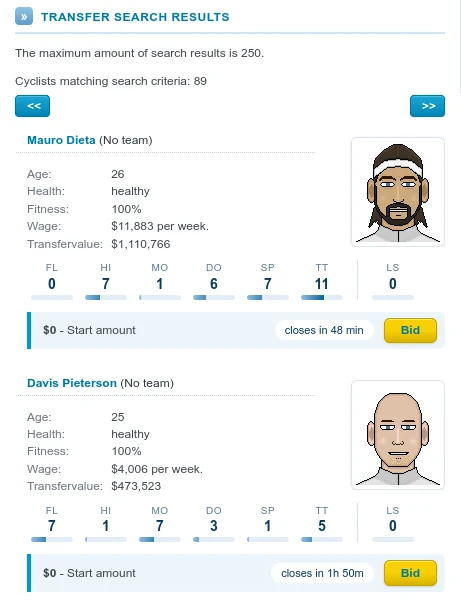
Available cyclists are on the transfer list. Select the option Search cyclists on the page Transfers. There are filters to specify your search.
How much to pay for a cyclist
At the moment most cyclists on the transfer list change hands for less than 20,000; cyclists with good skills cost more (100,000 or more). In the lower divisions you don't need an expensive top talent: at the beginning of your career, quantity is more important than quality.
Which primary skills to look for
When you search for new cyclists, consider the skill of your coach. Along with the skill that you train, you can develop different types of cyclists. Often you can find cyclists with one or two skills at a good level for little money.
For example, if you train mountain, you can develop a mountain sprinter (the new cyclist must already have a good sprint skill), an attacker in mountain races (decent sprint/TT skill), an attacker in hill/mountain races (good hill, decent sprint/TT skill), an attacker in flat/mountain races (good flat, decent sprint/TT skill), or a specialist for the grand tours (good flat/TT skill), ...
The level of the non-trainable skills is sufficient when you buy the cyclist. After some training of the mountain skill, your cyclists will be successful in certain stages. Of course it helps if the trained skill is already on a good level, too.
Which secondary skills to look for
At the beginning of your career you should especially look for cyclists with good primary skills. Good secondary skills are very helpful, but they are quite expensive, because they cannot be trained, and they don't affect the performance of the cyclist as much as the primary skills. Nevertheless, the higher the secondary skills, the better. For time jersey specialists in tours and for attackers a decent balance skill (more than about 7) is recommended, because a fall can cause a massive loss of time.
Experience and leadership are not part of a cyclist's value or wage, but players pay for them on the market. Look for one cyclist with a high leadership to be your team leader: he helps everybody in the race. An experienced cyclist gives you more than his price suggests.
Young or experienced cyclists?
Age isn't so important at the beginning either, with one exception: do not buy a cyclist to train him when he is old. Young cyclists improve faster and you can train them for the long term. Training slows down with age: a cyclist of 30 trains at the normal speed, a younger one faster, and from 30 on it is a little slower every year. At 35 the speed drops to a quarter, and from 36 the skills start to decrease every week. From 35 a cyclist can also retire at the end of a season, with a chance that doubles every year. So do not buy a cyclist of 34 or older to train him. But an older cyclist with already well-trained skills can help your team immediately and win important prize money. You should also have a few riders up to 21 years old in your squad to take part in U21 races and youngster competitions.
Youth scouts: find young talent
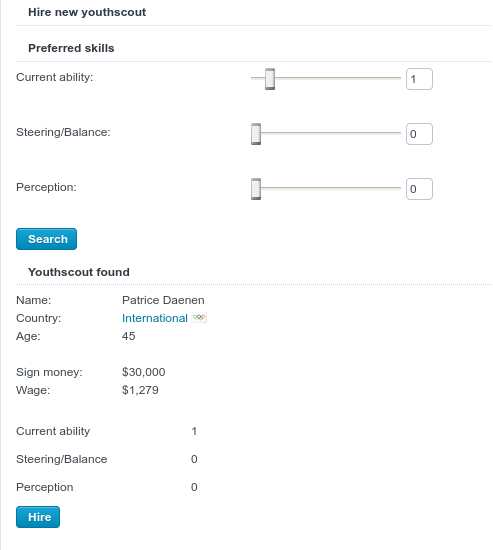
Don't buy a youth scout at the beginning of your career. Scouts are very expensive, especially the signing fee, and even rather poor scouts cost a lot. In the first seasons you benefit much more if you use your budget for a good trainer and some new cyclists.
After some seasons, when you have plenty of money left, you could think about buying one. A youth scout can build your own cyclists in the long term (so you don't have to buy expensive cyclists on the transfer market), sell talents (although only very good talents sell for a high price at the moment) and give you better possibilities in youngster competitions and U21 races.
The skills of a youth scout:
- Current ability: the better this skill, the better the primary skills of new talents can be.
- Steering/Balance: the better this skill, the better the steering and balance skills of new talents can be.
- Perception: the better this skill, the higher the probability to find a new young talent.
Your weekly routine
Before each race day, check your lineup (it closes at 12:45). Before Sunday 20:00, check your training selection and your merchandise stock. After the update, look at your fitness, your balance and your division standings.
Need more help?
Questions? The Peloton Wiki has the details of every part of the game, and on the forum other managers answer your questions. Fun races on Wednesday at 19:00 (CET/CEST) are a good place to test your tactics.
New to Peloton? Create your team, it is free. Already playing? Go back to the game.
Based on the original tutorial by seberla on the Peloton forum, rewritten and extended for the current game, November 2026.